Monster Phonics was created to improve outcomes through rigorous Systematic Synthetic Phonics, enhanced with carefully designed features that make learning more memorable and engaging for children.
A recent Master’s research study, ‘The Development of Year One Students’ Reading Ability in a Curriculum Using Monster Phonics Scheme in the UAE’ by Sara Berrandjia, United Arab Emirates University, examined the development of Year One children’s reading ability within a curriculum using Monster Phonics offers valuable practitioner-led insight into how that combination of structure and enhancement supports progress in real classrooms.
Importantly, the study was conducted in an international school in Abu Dhabi, where approximately 80 percent of the cohort were learning English as an Additional Language. This context makes the findings particularly relevant for linguistically diverse settings.
The research is firmly grounded in systematic synthetic phonics. It examines structured, explicit and cumulative teaching of grapheme phoneme 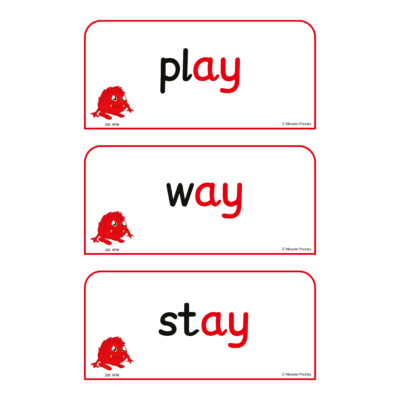 correspondences and blending. The findings show measurable gains in decoding accuracy, fluency and grapheme recognition across the study period.
What is particularly significant is the role of visual consistency in supporting retention. The study highlights that selective colour coding strengthened children’s ability to recall and apply sound–letter relationships when reading unfamiliar words. The visual consistency acted as a memory anchor, supporting retrieval and application.
The implications for children learning English as an Additional Language are therefore especially important. When children are acquiring vocabulary, new phonemes and unfamiliar spelling patterns at the same time, cognitive demand increases. The research suggests that structured visual associations reduced that load and supported faster retention of foundational knowledge.
In linguistically diverse classrooms, clarity and consistency matter. A multisensory approach with strong visual reinforcement can strengthen understanding and confidence, particularly for learners who may not have the same language exposure outside school.
Early reading remains one of the most powerful levers for equity in education. Children who establish strong foundations early access the wider curriculum with greater independence. Those who do not can quickly fall behind. The study indicates that a structured, enhanced SSP approach can support measurable progress within a relatively short period, which has clear implications for narrowing early gaps before they widen.
My background in science, followed by classroom teaching and school leadership, shaped my belief that phonics must be both evidence-informed and practical. In schools, the challenge is not whether phonics should be systematic. It is how to ensure children remember and apply what they are taught. Thoughtful design can make a meaningful difference.
From the very beginning, Monster Phonics has been built on a commitment to learning as much as teaching. Gathering evidence, listening to practitioners and reflecting on outcomes have all shaped the programme’s development. Research such as this strengthens our understanding of why certain features matter. We are keen to continue exploring the factors that contribute most significantly to impact, so that we can refine and improve the support we provide to schools.
Practitioner-led action research carries particular weight because it reflects the realities of everyday classrooms. This study confirms that systematic synthetic phonics, supported by carefully designed visual scaffolding, can drive measurable progress while maintaining engagement.
As we continue working with schools across the UK and internationally, particularly in contexts where EAL is the norm rather than the exception, research such as this strengthens our confidence in the approach.
We often say at Monster Phonics that we all live under one sky. For us, it captures a simple belief: wherever a child grows up, they deserve the strongest possible start. Learning to read transforms lives, and that opportunity should be shared by all.
Read the Full Article
The Development of Year One Students’ Reading Ability in a Curriculum Using Monster Phonics Scheme in the UAE
Sara Berrandjia, United Arab Emirates University