What is Letters and Sounds?
Letters and Sounds is a phonics teaching guide published by the Department for Education (DfE) in 2007. It set out a six-phase sequence for teaching synthetic phonics, from early listening skills in Nursery to spelling rules in Year 2, and it became the starting point for phonics teaching in many primary schools in England.
Letters and Sounds was guidance rather than a complete programme. Each school had to build its own lessons, resources and assessment around the handbook, and in many schools this led to differences between classes and year groups. In 2021 the DfE said that Letters and Sounds “isn’t a full systematic synthetic phonics programme”, and it encouraged schools to choose a complete, validated programme that provides teaching, resources, decodable books and training in one place.
The six phases of Letters and Sounds
Letters and Sounds splits phonics into six phases. Each phase builds on the one before. The timings below are the ones suggested in the original guidance. Many schools still use the phase names when they talk about phonics.
Phase 1 phonics
Phase 1 is about listening. Children tune in to the sounds around them, join in with rhymes and rhythm, and start to hear the separate sounds in spoken words. It usually happens in Nursery and carries on alongside the later phases. No letters are taught in Phase 1. In Monster Phonics, the Nursery Programme covers this pre-Phase 2 learning in a way that suits young children.
Phase 2 phonics
Phase 2 is when children start to learn letters and the sounds they make. It usually lasts about six weeks at the start of Reception. Children learn 23 graphemes in small sets. These are s, a, t, p, i, n, m, d, g, o, c, k, ck, e, u, r, h, b, f, ff, l, ll and ss. Children learn to blend these sounds to read simple words such as sat and pin, and to split words into sounds to spell them. The Phase 2 tricky words are the, to, I, no, go and into.
Phase 3 phonics
Phase 3 usually takes about twelve weeks in Reception. Children learn the rest of the alphabet (j, v, w, x, y, z, zz and qu). They also learn their first digraphs and trigraphs, where two or three letters make one sound. These are ch, sh, th, ng, ai, ee, igh, oa, oo, ar, or, ur, ow, oi, ear, air, ure and er. The Phase 3 tricky words are he, she, we, me, be, was, you, they, all, are, my and her.
Phase 4 phonics
Phase 4 teaches no new sounds. Children practise reading and spelling longer words with adjacent consonants, such as stop, crisp, tent and frog. It usually lasts four to six weeks at the end of Reception. The Phase 4 tricky words are said, have, like, so, do, some, come, were, there, little, one, when, out and what.
Phase 5 phonics
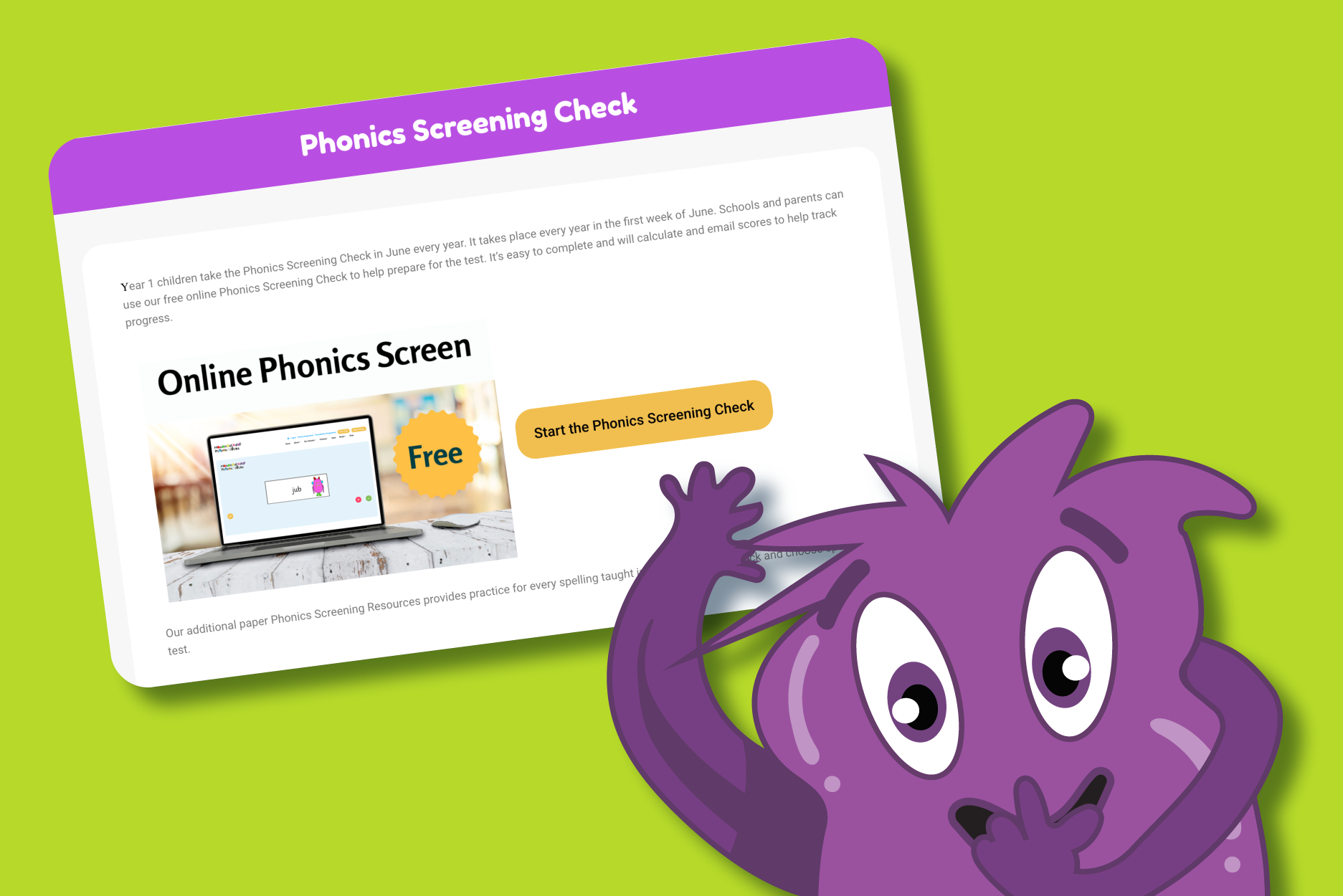
Phase 5 usually takes the whole of Year 1. Children learn new ways to spell sounds they already know, such as ay in play, ie in pie and ea in sea. The new graphemes are ay, ou, ie, ea, oy, ir, ue, aw, wh, ph, ew, oe, au, ey, a-e, e-e, i-e, o-e and u-e. Children also learn that some graphemes can make more than one sound, such as ow in cow and in snow. The Phase 5 tricky words are oh, their, people, Mr, Mrs, looked, called, asked and could. Phase 5 leads up to the Phonics Screening Check at the end of Year 1.
Phase 6 phonics
Phase 6 usually happens in Year 2, and the focus moves to spelling. Children learn the past tense, suffixes such as -ing, -ed, -er, -est, -ful, -ly and -ment, and how to spell longer words. This links to the spelling rules in the Year 2 National Curriculum.
Tricky words in each phase
See the tricky words for every phase, and how to teach the tricky part of each word, on our tricky words page.
Moving from Letters and Sounds to Monster Phonics
Monster Phonics is a complete systematic synthetic phonics (SSP) programme, validated by the DfE. It teaches all of the content in Letters and Sounds, and every statutory requirement for Reception and Key Stage 1, including the KS1 Spelling Curriculum. Every grapheme-phoneme correspondence and spelling rule is taught in a clear order, with daily lessons, resources, assessment and decodable books ready to use, so every class follows the same sequence. In Monster Phonics, the content of Phases 2 to 4 is taught in Reception, Phase 5 in Year 1 and Phase 6 in Year 2, with lessons, assessments and decodable books for each step. The Nursery Programme covers the learning that comes before Phase 2.
Because the content is familiar, schools moving from Letters and Sounds find the change easy to make. Staff keep the phonics knowledge they already have, and the Monster Phonics colour coding, characters and multisensory teaching help every child remember each sound.
Letters and Sounds Schools
See how Monster Phonics covers everything in Letters and Sounds and more, so moving to a full SSP is easy. Watch our on-demand demo, find out about our inclusive training, or get in touch to speak to one of our expert trainers.
Results in Monster Phonics schools
Schools consistently report higher engagement and faster progress, and a typical Monster Phonics school achieves an average 92% pass rate in the Phonics Screening Check.
Practice, Free Tools & Newsletter
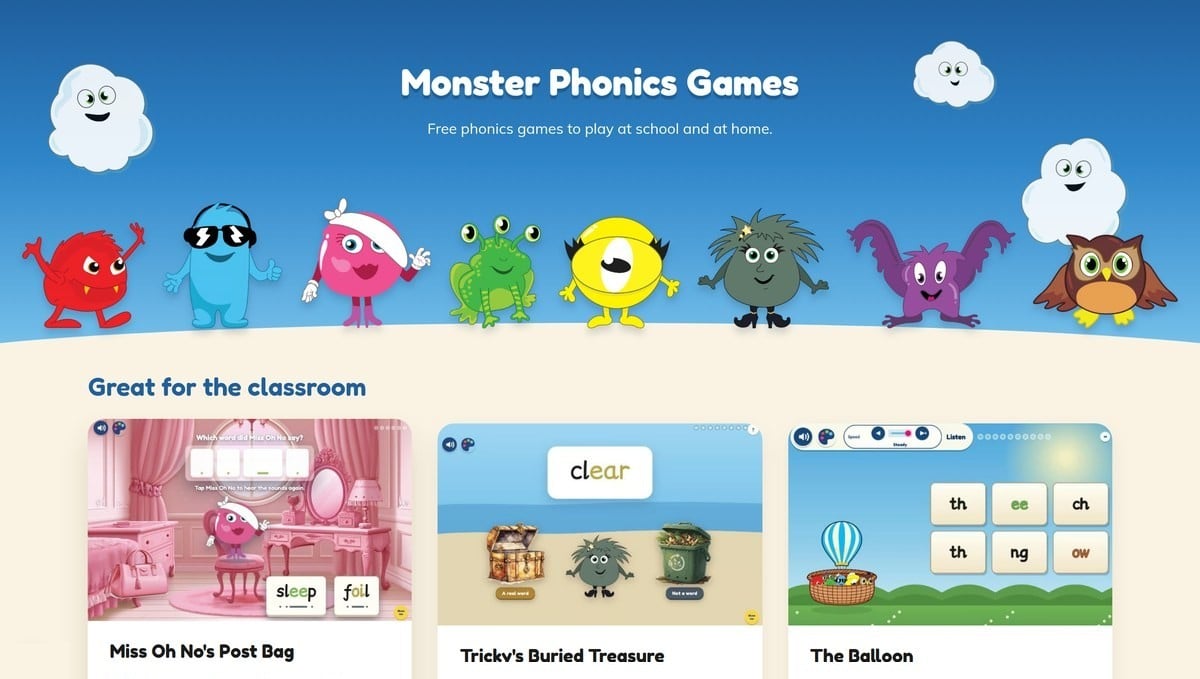
Free ways to practise phonics in the classroom and at home, and a newsletter with more free resources by email.